


A federal agent in Minnesota grabbed a woman’s phone as it recorded him approaching her Jan. 9, two days after a federal agent shot a U.S. citizen. “Have y’all not learned from the past couple of days?” the agent asked the woman.
Weeks later in Maine, a woman let her phone camera roll as an agent filmed her license plate and told her her name would be added to a database and she was now considered a domestic terrorist.
“For videotaping you?” the woman asked. “Are you crazy?”
And on Jan. 29, a Minnesota driver with a dash cam filmed masked immigration agents as they swerved in front of her car, got out of their vehicle and pulled their guns.
What are the rules around filming immigration agents in public?
Minnesota Gov. Tim Walz encouraged the state’s residents to record agents to create a record of evidence. Bystanders’ video footage has been critical in painting fuller pictures of what happened in agent’s confrontations with civilians, including the fatal shootings of Alex Pretti and Renee Good.
Homeland Security Secretary Kristi Noem, who is overseeing the Trump administration’s immigration enforcement tactics, said recording on-duty immigration agents is an act of violence. The department’s spokesperson also called videoing officers “doxing,” a “federal crime and a felony.”
After immigration agents fatally shot Pretti, bystander video from multiple angles challenged Noem’s statements that Pretti had brandished his gun at immigration agents before he was killed.
The incidents reveal tension between the public’s First Amendment protections and what law enforcement officers see as obstruction.
A federal judge in January ruled against DHS’ attempt to dismiss a case brought by journalists who say the department infringed on their constitutional rights while they were covering immigration enforcement in California. The judge said the journalists had established that DHS has a policy considering filming immigration agents as unlawful civil unrest.
We spoke to five legal experts about bystanders’ rights when recording immigration agents.
“Knowing your rights is paramount. Reminding officers of your rights is important. Standing on your rights is a personal decision,” Kevin Goldberg, vice president at Freedom Forum, a First Amendment rights advocacy group, said.
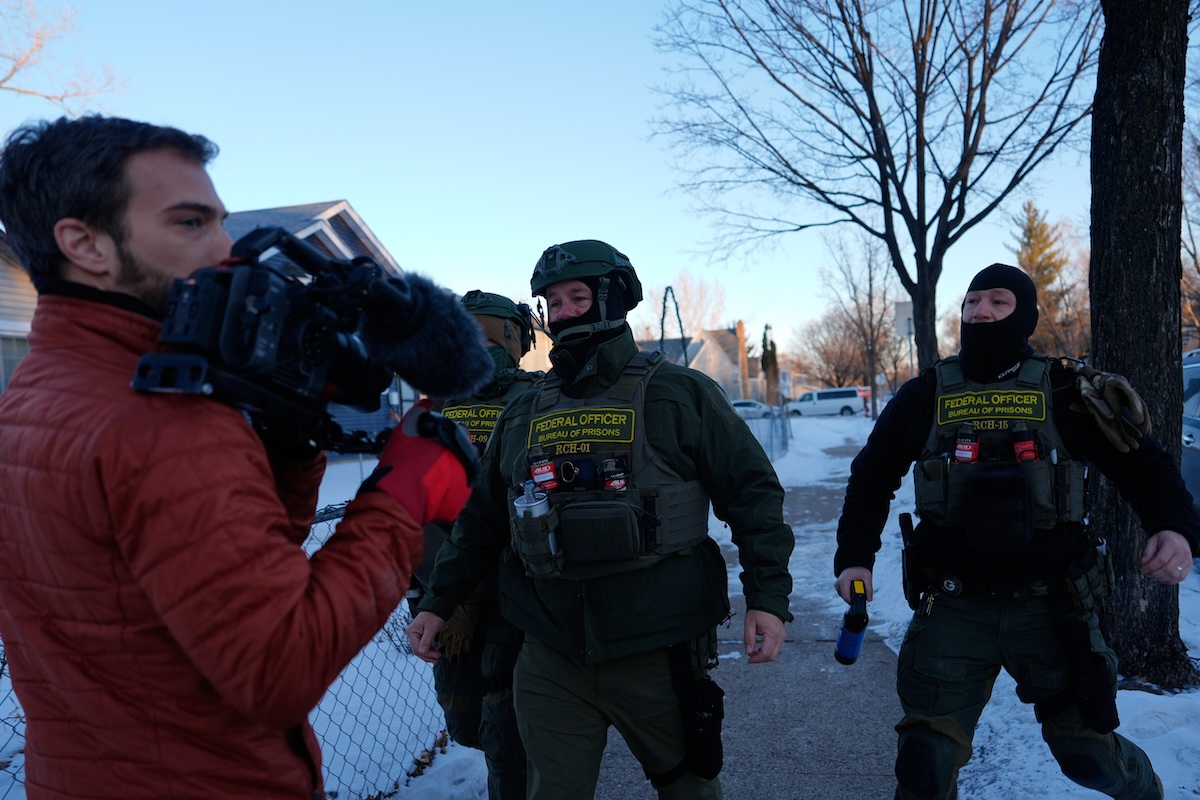
Federal Bureau of Prisons officers threaten Associated Press video journalist Mark Vancleave with arrest on Jan. 28, 2026, in Minneapolis. (AP)
Is it legal to record immigration officials?
Yes. Recording in public is allowed under the First Amendment.
A few states require bystanders to stay a certain distance away from first responders. For example, under Florida’s Halo Lawpeople are required to stay at least 25 feet away from law enforcement officers, firefighters and emergency medical responders.
Some buffer-zone laws, such as one in Indiana, have been struck down in federal courts.
What does it mean to obstruct law enforcement?
Even though it’s legal to record law enforcement officers in public, it is not legal to obstruct their activities.
Obstructing law enforcement generally requires physical action under federal lawlegal experts said, such as standing between an officer and the person they’re trying to arrest. An obstruction must impede officers from carrying out their duties, which is why filming or yelling doesn’t count, Rachel Moran, a law professor at the University of St. Thomas in St. Paul, Minnesota, said.
Immigration agents have accused several bystanders who record them of obstruction.
In many cases agents approach people who are in their cars recording agents. Agents tell the bystanders that this is their one warning and if they continue to follow the agent they will be arrested for obstructing.
Goldberg said, “Holding up a camera at an appropriate distance and filming should not inhibit any law enforcement officials from doing their jobs unless they think they’re doing something wrong.”
A federal judge ruled Jan. 16 that following federal agents “at an appropriate distance does not, by itself, create reasonable suspicion to justify a vehicle stop.”
An appeals court temporarily paused that order.
“Following a police car or ICE vehicle on a public road is not obstructing,” Jessica West, a professor at Mitchell Hamline School of Law, said. “Blocking a car in to prevent it from moving in the direction it was headed, might be considered obstructing.”
Moran agreed, she said the only way following an ICE officer could rise to the level of obstruction would be if a person yelled threats at an officer or drove so close to them “that the agents reasonably believed they were in danger of getting hit.”
People’s rights to observe and record law enforcement officers don’t change when someone is in a car, Goldberg said. However, because cars take up more space they can increase the likelihood of an obstruction in small spaces.
“People are allowed to drive cars on public roads. People are allowed to film from public spaces. But all rules of the road must be followed,” Goldberg said.
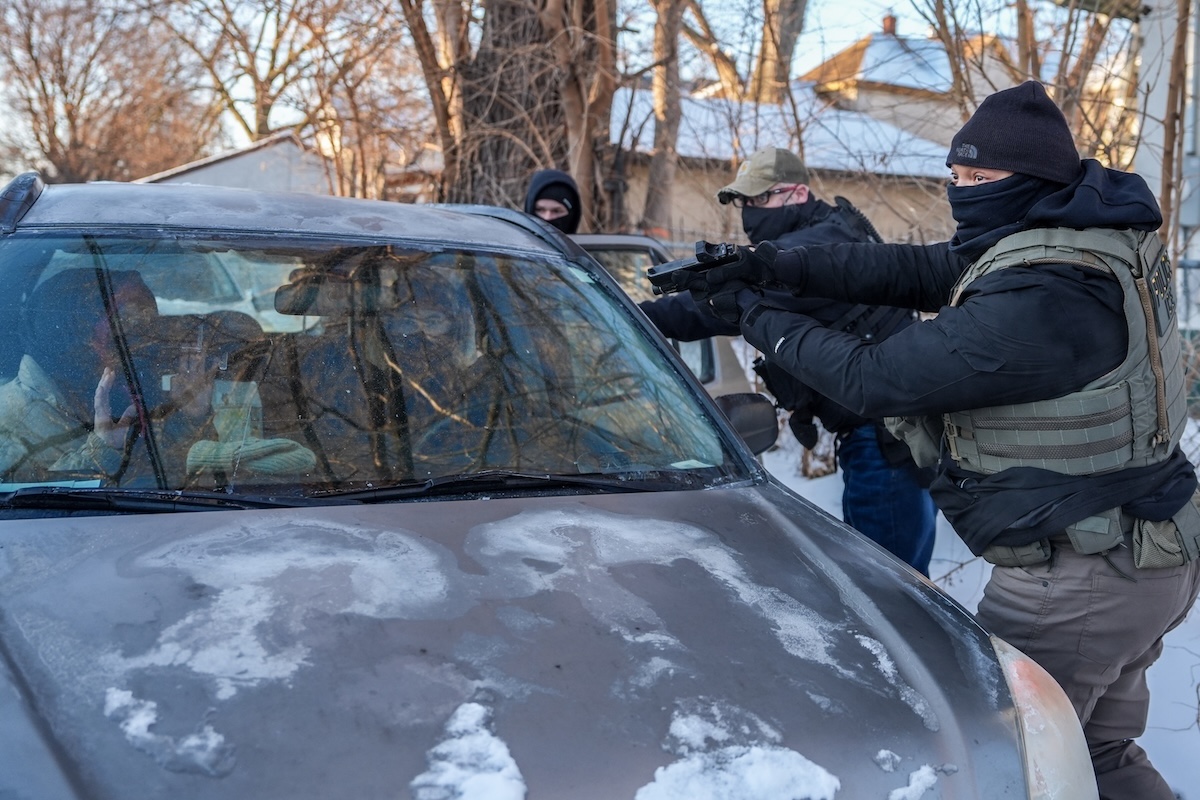
Federal agent brandishing a firearm approaches activists for following agent vehicles Tuesday, Feb. 3, 2026, in Minneapolis. (AP)
Who decides obstruction?
The decision about whether someone is obstructing law enforcement can be subjective.
First, a law enforcement officer must determine that there is probable cause — meaning, it’s more likely than not — that someone physically obstructed their actions, West said. Once that’s determined, the officer can make an arrest.
A judge or a grand jury reviews the evidence and decides whether to charge the person. If charged, a judge or jury decides whether to convict.
“Courts have given a lot of deference to law enforcement officials and so that is something that anyone who’s recording should be aware of,” Goldberg said.
However, several grand juries have recently refused to indict cases related to impeding or assaulting immigration officers. Other cases have been dismissed.
Can immigration agents take an observer’s phone or legally compel them to stop recording?
Immigration agents cannot legally compel somebody to stop recording so long as the person is not obstructing their work. They may tell observers to step back for safety reasons.
There have been recent cases of agents acting unconstitutionally by yelling at people to stop recording or knocking phones out of people’s hands.
“It can be scary to maintain your rights when an agent is threatening you so ultimately it is the choice of the person recording whether to continue doing that and risk retaliation by the government,” Moran said.
Agents also can’t take phones without arresting people.
“It is a violation of civil rights to confiscate someone’s phone or other recording device if they are merely recording and not actively interfering with or obstructing law enforcement activities,” Timothy Zick, a constitutional law professor at William and Mary, said.
Legal experts recommend disabling Face ID as that might make it easier for officers to unlock a phone.
To search a person’s phone, agents need a warrant signed by a judge.
Is recording law enforcement officers doxing and, if so, is that illegal?
Homeland Security officials have said that recording immigration agents is a form of doxing, which means publicly identifying or publishing private information about a person, especially as a form of punishment or revenge. (However, DHS’s social media profiles include several videos and photos of immigration agents conducting enforcement operations.)
Legal experts agreed that recording an immigration agent in public is not considered doxing.
“It is not doxing to film something that is happening in public, even though somebody would rather not have that information public,” Goldberg said. “Even if someone is masked to hide their identity.”
Doxing often refers to publishing personal information, such as home or email addresses, phone numbers or private financial information, without someone’s consent.
Some states have anti-doxing laws that hinge on whether there was an intention to harass or harm someone.
