


A 2014 paper on this topic:
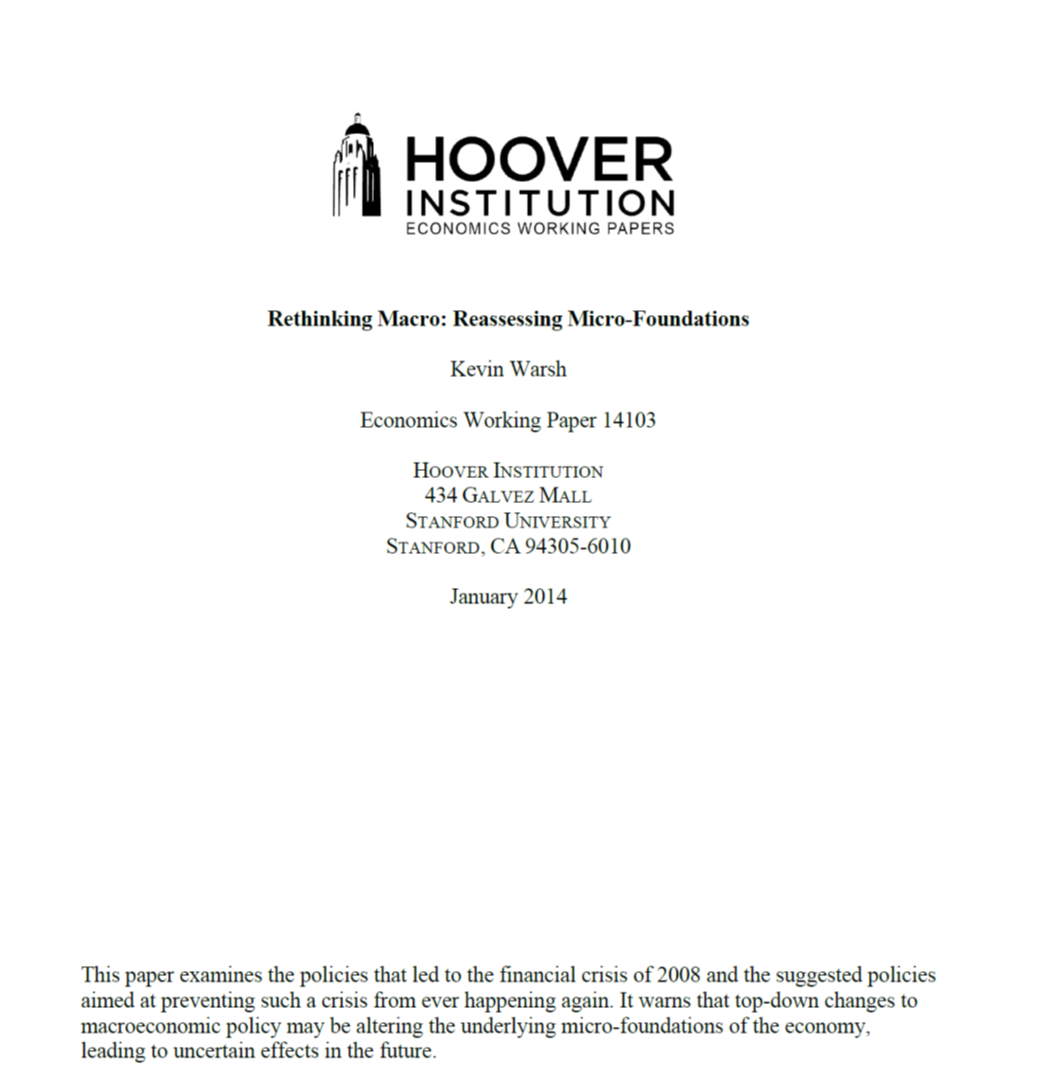
Don’t ask me what it all means. I think it has an Austrian flavor, but maybe that’s just me.
As noted, the paper is from 2014. I think some DSGE’s now incorporate financial frictions, but I defer to others on this point.
Addendum, 11:50am Pacific:
I’m not sure Wars knew what he was talking about (as of 2014).
If, for example, the Federal Reserve’s FRB/US model—among the foremost DSGE models—
estimates that the unemployment rate will remain above the natural rate of unemployment for a couple more years, that tends to weigh heavily on the staff’s judgmental forecast. In my
experience, the staff forecast then plays a central role—maybe even an anchoring role—from
which many members of the FOMC make their individual forecasts. The latest iterations of the Fed’s model, if they are believed, provide ample rationale for continuation of highly
accommodative policy.
See this description of FRB/US (2014) and how the authors contrast FRB/US of the time with DSGEs.
Comparing the design of FRB/US to the DSGE modeling approach
As is already evident from this brief description, FRB/US differs along several dimensions from many dynamic stochastic general equilibrium (DSGE) models in current use. For example:
- Because FRB/US is not built around a representative household paradigm, it is more generously parameterized than typical DSGE models and dispenses with many of the cross-equation restrictions imposed by the latter. Notably, future income is valued by different discount factors depending on whether it accrues to households or firms. Also, the marginal propensity of households to consume out of different types of income can vary, depending on which group of households receives the income. For example, transfer income is disproportionately received by retirees who are well-advanced in their lifecycles.
- Some optimization problems are specified in a different fashion in FRB/US than in many DSGE models. As noted earlier, the FRB/US specification of consumer spending bases the valuation of a large component of human wealth on a discount rate that is both fixed and quite large, implying that the effective planning horizon for many households in FRB/US is closer to the five years advocated by Friedman (1957) than to the much longer period embedded in a typical DSGE model (Carroll, 2001). In addition, the growth of consumer spending in FRB/US is not closely linked to the path of expected future short-term (risk-free) interest rates as it is in the Euler equation specification of consumption used in most DSGE models; rather, the level of spending in the model depends directly on intermediate-term consumer loan rates and indirectly on the long-term bond rates that influence the value of corporate equities.
- Another important dimension along which FRB/US is different from many DSGE models used in policy analysis is that the model allows for nonlinear interactions among endogenous variables, in contrast to the common practice of writing models as linear approximations around a steady state or balanced-growth path. For example, the model’s estimate of the average interest elasticity of aggregate demand has changed markedly over time as the composition of GDP has evolved; in particular, the aggregate elasticity fell sharply with the recent collapse of residential construction, because it is the most interest-sensitive sector of the economy. Another important nonlinearity concerns the zero lower bound on nominal interest rates, which has constrained the actual and expected future stance of monetary policy markedly since late 2008. It is straightforward in FRB/US to model the short-term policy rate as a feedback rule subject to the zero lower bound.8
- Broadly speaking, the eclectic approach to the specification of FRB/US permits the historical patterns in macroeconomic data to influence its structure more substantially than is the case for the typical DSGE model, whose structure is more tightly imposed by economic theory. Recognizing that this and other issues about the best design of a macroeconomic model are the subjects of ongoing debate, the staff at the Federal Reserve Board has also developed and uses the OR and SIGMA DSGE models.9
I’m pretty confident that the late Thomas Laubach and David Reifschneider knew what they were writing about.
