


Sports betting ads are inescapable on social media, TV and radio. As March Madness ramps up, their prevalence is likely to intensify: The American Gaming Association estimates that Americans will wager $3.3 billion on this year’s NCAA men’s and women’s basketball tournaments.
The ads promise big rewards and feature athletes or smiling, cheering customers.
They often offer enticing new player promotions such as “up to $1,500 paid back in bonus bets” if you don’t win.
Sports gambling is more popular than ever after the Supreme Court struck down a federal law prohibiting sports betting in most states. Sports betting is legal in some form in 39 states and Washington D.C., and 32 states allow sports betting through online and mobile sportsbooks. States earn money by taxing money won from sports betting.
As profits from sports betting companies such as DraftKings and FanDuel have ballooned, so have gambling concerns.
Online searches for gambling addiction help have risen 23% since the 2018 Supreme Court decision, a 2025 JAMA Internal Medicine study found.
Gambling today has lost much of its past social stigma, experts said. Forty-eight percent of men ages 18 to 49 have an account with at least one online sportsbook, a 2025 Siena Research Institute poll found. That’s also true of 22% of Americans broadly, the poll found.
The attitude shift — combined with the fact that mobile apps make it possible for people to access virtual casinos in their pockets — means higher chances of developing a gambling disorder.
We talked to experts about how to recognize concerning gambling behaviors and what you can do if you fear a loved one might have harmful or unhealthy gambling habits.
What are signs or symptoms of gambling disorder?
Gambling disorder is characterized by repeated betting and wagering that continues even as it creates problems in several areas of a person’s life.
A person chasing their losses — making another bet to try to recoup the money lost on a previous wager — is one sign of a gambling disorder, said Jeff Derevensky, director of McGill University’s International Centre for Youth Gambling Problems and High-Risk Behaviours.
If you’re concerned about a loved one’s gambling, keep an eye out for significant changes in that person’s behavior.
A few telltale signs: constantly looking at sports betting apps, sneaking away to check game scores or athletes’ performances, or spending more money than they have on sporting events.
A person with gambling disorder could experience worsening anxiety, mood swings, difficulty concentrating or trouble sleeping, said Dr. Trent Hall, an Ohio State University addiction medicine specialist. They might also withdraw from relationships, stop engaging with activities they once enjoyed, and be secretive about finances and gambling debts.
The American Psychiatric Association says that a clinical gambling disorder diagnosis applies when a person meets at least four diagnostic criteria in the last year, including: frequently thinking about gambling; needing to gamble with increasing amounts; repeatedly trying without success to cut back or stop gambling; experiencing increased irritability while trying to stop gambling; feeling the need to get even or chase losses; and lying to hide gambling.
Because people can gamble with ease from their phones, gambling disorders are often hidden.
“Unlike with substance use disorders, there are usually no obvious physical signs,” Hall said.
Gambling disorder often doesn’t become obvious, he said, until a person begins to experience some of its most devastating consequences — debt, bankruptcy, job loss, a mental health crisis or suicidal behavior.
What separates casual, recreational gambling from gambling that’s more problematic?
The deciding factor is not how much money a person has lost, but if the gambling is constant or compulsive.
When someone gambles occasionally or recreationally, Derevensky said they often do so by setting limits on both the time and money they’ll spend gambling. It becomes problematic when a person exceeds those limits, seems preoccupied with gambling or monitoring sporting events or undergoes dramatic behavior changes.
Who is at risk of developing gambling disorder?
Anyone who gambles could develop gambling disorder, the National Council on Problem Gambling says.
Children and teenagers are at a higher risk for gambling disorder, partly because of adolescent impulsivityand so are people who started gambling at a young age.
Men and boys and people in low-income households who could stand to gain more from gambling wins are also more at risk, experts said.

At the NASCAR Hall of Fame, Fox Sports broadcaster Greg Olsen retrieves his receipt after placing the first ceremonial bet in North Carolina during a DraftKings event celebrating the launch of mobile and online sports wagering across the state, March 11, 2024, in Charlotte, N.C.
What should I do if I think my loved one might have a gambling problem?
Start by having a calm conversation with your loved one that focuses on your concerns.
Avoid blaming, judging, criticizing or nagging when starting the conversation.
Start with “I” statements, such as, “I’m worried that your gambling is going to lead to more financial damage,” or “I’m worried about you because you haven’t been present for our family activities,” Dr. Timothy Fong, a UCLA psychiatry professor, said. Tell your loved one how their gambling is affecting you, he said.
Visit the National Council on Problem Gambling’s website or call its helpline at 1-800-MY-RESET. The group provides support and connection to local resources.
Family members can also work to educate themselves on gambling disorder and recovery, Fong said. He recommended the podcasts “The Broke Girl Society” and “All In: The Addicted Gambler’s Podcast” as places to start.
What shouldn’t I do?
Don’t expect immediate recovery. Hall said it’s important to know that change takes time.
You also shouldn’t try to bail someone out by giving them money, Fong said. Family members often give loved ones thousands of dollars or pay credit card bills in an effort to prevent suffering or bad credit, but these efforts are ultimately enabling, Fong said.
Finally, don’t try to manage the situation alone — seek guidance or support for yourself. A support group such as Gam-Anon could be a good place to start, Hall said.
How is gambling disorder treated?
The best treatments for gambling disorder include cognitive behavioral therapy and motivational interviewing
“Cognitive behavioral therapy helps people challenge distorted thoughts that may be driving them to gamble,” Hall said. “Motivational interviewing brings out and strengthens an individual’s own inner strengths and reasons for personal growth and change. It is especially helpful when people have mixed feelings about their gambling.”
Groups such as Gamblers Anonymous and SMART Recovery connect people with gambling disorder. There is no medication approved by the Food and Drug Administration to treat gambling disorder. Early research shows promise for naltrexone, a medication prescribed to treat some substance use disorders, Hall said. And many people with gambling disorder might be able to stop gambling if they receive treatment for other mental health conditions such as anxiety or depression, he said.
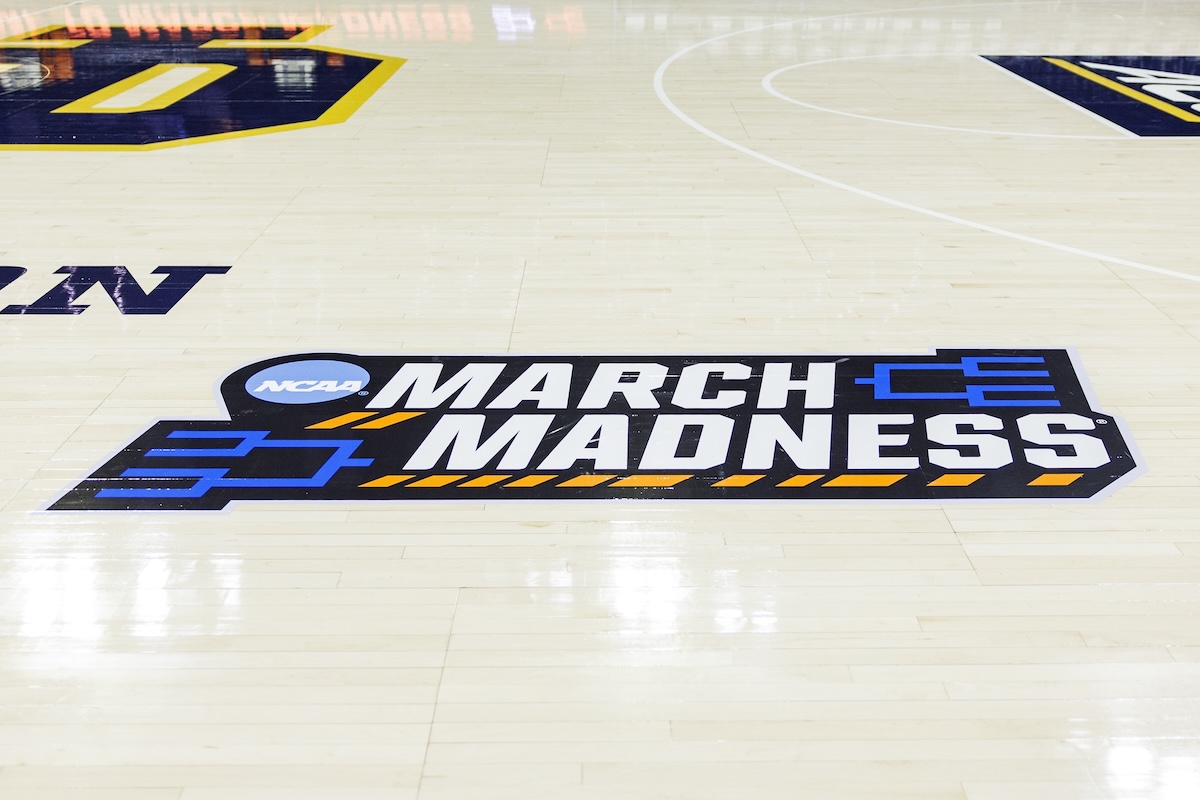
March Madness logo displayed on the court prior to second round of the NCAA college 2025 basketball tournament between Notre Dame and Michigan, March 23, 2025, in South Bend, Ind. (AP)
What do I need to know before betting on March Madness?
Sports betting apps have heightened the risks of developing a gambling problem.
Sportsbooks are highly sophisticated apps that track user behavior and encourage engagement by design, said Brendan Dwyer, a professor at Virginia Commonwealth University who studies consumer behavior around sports.
“They often promote entertaining, long-odds bets like parlays,” Dwyer said. “They also use notifications to prompt continued betting, increase frequency and encourage chasing losses.”
To manage impulsivity, he recommended disabling app notifications, setting a weekly or monthly deposit limit and a maximum bet size, and building in friction such as delays between live bets.
Gambling is really meant to be enjoyable or a form of entertainment, Fong said.
“It’s not a side gig, it’s not an investment tool,” he said. “Gambling, by definition, is risky, and you will lose and spend money on that activity.”
Using mobile apps, it’s possible to gamble continuously. And that’s more problematic.
When Derevensky was young, he said betting on sports typically meant placing a bet before the game started and then waiting to see if the wager would win or lose.
No longer. “You could bet on who’s going to be ahead in the first period,” he said. “You could bet on individual players. You could bet on so many different things during the game.”
Editor’s Note: If you or someone you know is struggling with suicidal thoughts, call the National Suicide Prevention Lifeline at 988 (or 800-273-8255) to connect with a trained counselor.
