


- Every line trending upward, every drop in cost, every additional ounce of efficiency we can squeeze from a bundle of inputs is the product of deliberate effort—of thousands of workers, engineers, factory managers, and line supervisors redesigning products, rearranging factories, testing and exploring new ways to do things.
- —Brian Potter, The Origins of Efficiency (304)
Economists look at productivity gains in the aggregate. Rather than examine where they come from, we simply utter the phrase “technological change.”
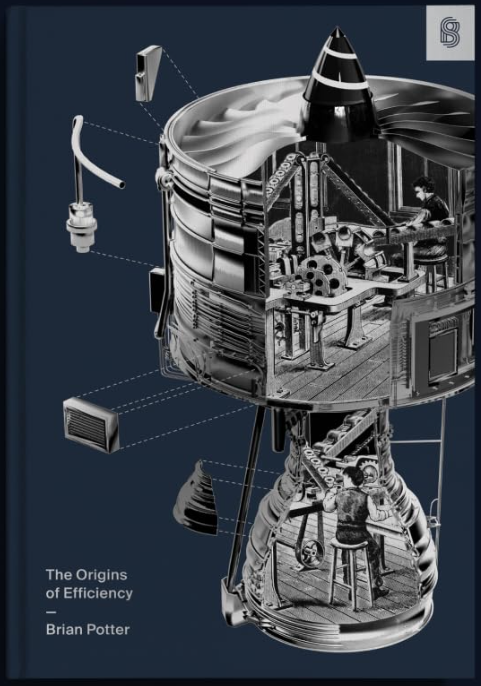
Brian Potter’s recent book, The Origins of Efficiency, takes a bottom-up approach to looking at productivity improvement. Potter describes various ways that firms lower the cost of production. His many historical examples serve to illustrate and clarify the analysis.
Potter looks at production in terms of transforming inputs into outputs, in which the efficiency of the process depends on five factors: the transformation method; the production rate; the cost of inputs; the size of the buffer (work in process); the variability of the output.
For example, in a bread bakery, the transformation method is the set of instructions for making a loaf of bread. The production rate is the number of loaves per hour. The cost of inputs is the cost of flour, yeast, sugar, salt, energy, labor, and so on. The work in process consists of loaves that have been formed but not yet put in the oven. If the loaves are allowed to rise for different amounts of time, this will cause variability in output.
“Through theoretical study as well as trial and error, enough of the problems get solved, and a dominant design emerges that attracts many tinkerers who proceed to improve the technology.”
Potter points out that new transformation methods tend to follow an S-curve of improvement. A new technique may seem promising, but it starts out with a low level of performance and progress is slow, because there are many problems that make it costly or impractical. Through theoretical study as well as trial and error, enough of the problems get solved, and a dominant design emerges that attracts many tinkerers who proceed to improve the technology. Progress then accelerates rapidly. Eventually, there are fewer remaining opportunities to wring improvement out of the technology, and productivity levels off.
- “An S-curve pattern means that early on, a new technology often performs significantly worse than an established technology along the most important measures of performance, even if its theoretical performance ceiling is much higher.” (50)
Mechanization can dramatically lower costs. Potter uses the example of glass bulbs for electric lights being blown by machines rather than by humans. But he points out that humans have better ability to adjust to different conditions and to work with softer and more variable materials.
- “Successful mechanization has thus historically required reducing or otherwise limiting the amount of information processing that must be performed and the environmental variation that must be considered.” (70)
One interesting source of efficiency is removing unnecessary steps in the production process. For example, in an assembly line, if you raise the conveyor belt, the workers will not have to bend and lift objects.
Modern writers often use scare quotes to describe “scientific management” or “Taylorism,” creating the impression that time-and-motion studies were instruments of oppression aimed at individual workers. But from Potter I learned that time-and-motion studies were used to discover ways to improve manufacturing processes. Raising the height of the conveyor belt is an example of scientific management that is a win-win for workers and for the manufacturer.
As I was reading The Origins of EfficiencyI saw many ways in which the analysis applies to the latest developments in artificial intelligence. For example, the release of ChatGPT attracted capital and inventors to similar models using neural networks and the “transformer” algorithm. We are now on the steep portion of the S-curve of improvement.
Although ordinary machines lack flexibility and adaptability, artificial intelligence may enable machines to overcome this limitation. Self-driving cars are one example.
The field of robotics could improve dramatically using AI. Today, a nurse or phlebotomist is needed in order to start an intravenous drip for a hospital patient. Perhaps by using AI, a robot could handle this task. Construction workers today rely on subtle knowledge and experience that is beyond the capacity of ordinary machines. But perhaps in the future AI-enabled robots could perform more tasks in construction.
I can see ample opportunity for AI to eliminate unnecessary steps in the provision of goods and services. For example, a corporation does not need to design an elaborate menu on its web site. Instead, users can rely on an AI interface to find the information that they need.
But in important lesson from Potter’s book is that applications of promising technologies are slow to develop.
- “Fixing one problem with a nascent technology tends to simply reveal more problems, so significant time and effort might be invested without any noticeable increase in performance.” (40)
For more on these topics, see
As of this writing, early adopters of AI may be feeling this pain.
The Origins of Efficiency is a book that defies easy summary. The many useful concepts and well-chosen illustrative examples give it a richness that is best appreciated by taking it in as a whole.
Footnotes
[1]Brian Potter (2025), The Origins of Efficiency. Stripe Press.
*Arnold Kling has a Ph.D. in economics from the Massachusetts Institute of Technology. He is the author of several books, including Crisis of Abundance: Rethinking How We Pay for Health Care; Invisible Wealth: The Hidden Story of How Markets Work; Unchecked and Unbalanced: How the Discrepancy Between Knowledge and Power Caused the Financial Crisis and Threatens Democracy; and Specialization and Trade: A Re-introduction to Economics. He contributed to EconLog from January 2003 through August 2012.
Read more of what Arnold Kling’s been reading. For more book reviews and articles by Arnold Kling, see the Archive.
