


President Donald Trump sent Immigration and Customs Enforcement officers to some U.S. airports starting March 23 in an attempt to alleviate hours-long security wait times amid a partial government shutdown.
“We put ICE in charge, they are helping (Transportation Security Administration) agents,” Trump said at a Memphis, Tennessee, event. It isn’t clear what the officers’ roles will be. Trump also said he would consider deploying the National Guard if needed.
There’s one important difference between ICE and TSA agents: ICE agents are still being paid, but TSA agents have not been paid for more than a month.
The impasse over funding stems from federal agents’ killing of U.S. citizens Renee Good and Alex Pretti in Minnesota. Democrats are demanding policy changes in immigration officer’s tactics such as requiring them to wear body cameras and not wear masks.
Both parties agreed to fund the rest of the government while they sought a Department of Homeland Security funding compromise.
With negotiations dragging, hundreds of TSA agents have quit during the partial shutdown and thousands of others have called out of work.
While both ICE and TSA are funded by DHS, they are treated differently during the partial government shutdown. Here’s why.
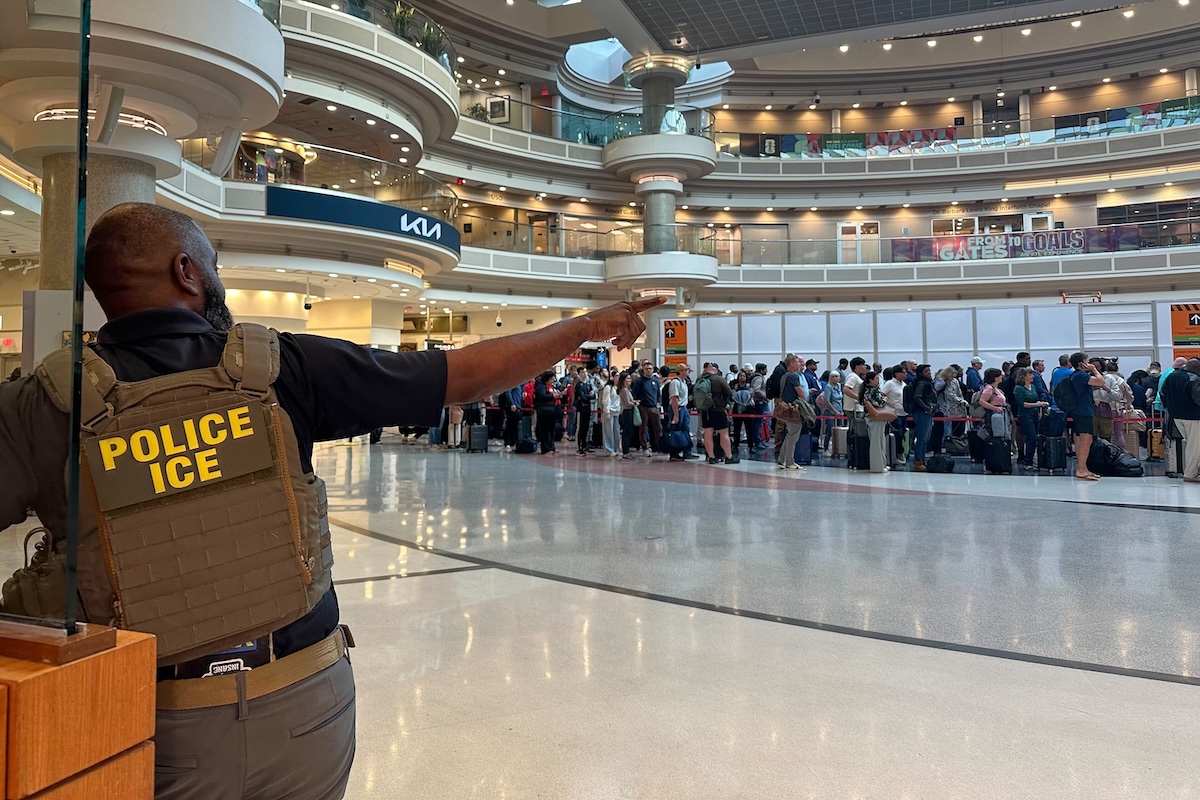
A federal immigration agent is seen as people wait in a TSA line at the Hartsfield-Jackson Atlanta International Airport, March 23, 2026, in Atlanta. (AP)
Why is ICE funded but not TSA?
Trump’s One Big Beautiful Bill Act is paying ICE agents.
Trump’s signature 2025 tax and spending law included about $75 billion for ICE over four years, including $45 billion for new immigration detention beds and $30 billion to hire 10,000 ICE employees, upgrade facilities and more.
TSA remains without funding. During government shutdowns, employees are not paid, including those deemed essential who are still required to report to work. About 95% of TSA’s 60,000 employees are considered essential workers.
A 2019 law requires the government to pay back employees when funding resumes. Following the 43-day shutdown in fall 2025 — the longest shutdown in U.S. history — outgoing Homeland Security Secretary Kristi Noem awarded $10,000 bonuses to TSA officers with “exemplary service” during the shutdown.
What changes are Democrats demanding for ICE?
In a February letter to Republican leaders in Congress, Democratic leaders listed 10 measures they wanted to enact to rein in ICE tactics.
The biggest Democratic-led changes would require immigration officers to:
Have a judicial warrant to enter private property.
Display names and ID numbers.
Not use conduct enforcement near hospitals, schools or churches.
Not wear face coverings.
Use body cameras.
On March 17, border czar Tom Homan and White House legislative affairs director James Braid countered with a proposed expansion of body camera use, limited enforcement in hospitals and schools, and more visible officer identification.
Some congressional Democrats said the proposal fell short and didn’t codify changes into law, The Hill reported.
Democrats, Republicans seek ways to fund TSA while ICE negotiations continue
A Democratic motion to fund some of DHS — including TSA, the Federal Emergency Management Agency and the Coast Guard — failed along party lines March 21.
Separately, Sen. Ted Cruz, R-Texas, also proposed breaking up DHS spending bills and funding TSA immediately, according to The Hill. He said Republicans could then fund ICE and Customs and Border Protection through the budget reconciliation process that would let Republicans maneuver around a Democratic filibuster. Even though ICE and CBP are using the additional money they got from the One Big Beautiful Bill during the shutdown, they still need to go through the appropriations process to secure the rest of their funding.
In a Truth Social post, Trump said Republicans shouldn’t make a deal with Democrats until Democrats vote to pass the SAVE America Act, a bill that would change federal requirements for voter registration.
What will ICE do at airports?
When ICE officers deployed to several airports across the country, it wasn’t clear what their role would be.
Homan said March 22 he was working on a plan.
“I don’t see an ICE agent looking at an X-ray machine, because we’re not trained in that,” Homan said on CNN’s “State of the Union” March 22. He added that ICE agents could help secure exits.
Trump told reporters March 23 that ICE agents at airports could arrest immigrants who are in the U.S. illegally “as they enter the country,” but said that’s not why the agents are there. “They’re there to help.”
CBP officers determine at airports whether people traveling into the U.S. are legally allowed to enter the country.
